Meeting Big Pine Key’s Smallest Resident: What It Takes to Protect the Key Deer
Encountering the Lower Keys Pocket-Sized Icon
Driving south along the Overseas Highway, the Lower Keys gradually trade dense coastal mangroves for open stretches of pine rockland, hardwood hammock, freshwater pockets, and salt-marsh edges. On Big Pine Key, that changing landscape comes with an extraordinary possibility: a small deer stepping quietly from the vegetation, pausing beside a residential road, or browsing near a refuge trail. The sighting can feel almost otherworldly, especially when the afternoon light catches the deer”s reddish coat and compact silhouette.
The Key deer is the smallest subspecies of North American white-tailed deer, found naturally only in the lower Florida Keys. Its survival is a conservation success story, but not a license for close contact. Every visitor enters a landscape where roads, homes, seasonal flooding, scarce freshwater, and rising seas overlap with critical wildlife habitat. Observing a Key deer is therefore both a privilege and a responsibility: the best encounter is one that leaves the animal undisturbed and the island ecosystem no worse for the visit.
The Biology of Island Dwarfism and Pine Rockland Ecology
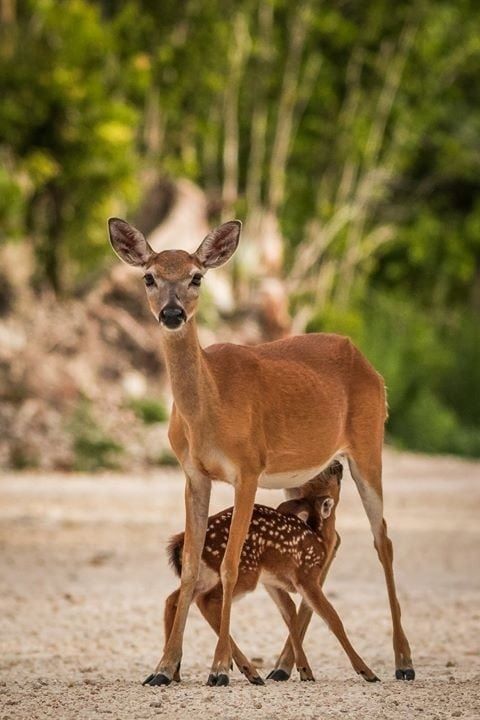
Key deer are an example of insular dwarfism, a process in which an animal population isolated on islands evolves toward a smaller body size over many generations. On the Florida Keys, limited land area, restricted food resources, freshwater scarcity, and the absence of the broad mainland landscape favored a compact form. Smaller bodies require fewer calories, an important advantage where habitat is fragmented among limestone islands, wetlands, mangroves, and developed areas.
The difference is easy to appreciate when a Key deer is seen beside a familiar mainland white-tailed deer. Adult bucks commonly reach only about 28 to 32 inches at the shoulder and weigh approximately 80 pounds. Does are smaller, averaging around 65 pounds. Mainland white-tailed deer vary widely by region, but many adult males are substantially taller and heavier. The comparison below offers a practical reference rather than a rigid rule, since age, season, sex, and individual health all affect size.
| Deer type | Typical size reference | Useful field impression |
|---|---|---|
| Key deer buck | About 28 to 32 inches at the shoulder and approximately 80 pounds | Compact, slender, and noticeably smaller than most mainland bucks |
| Key deer doe | Approximately 65 pounds on average | Smaller-bodied and often delicate in appearance |
| Mainland white-tailed deer | Highly variable by region, often considerably larger | Generally taller and heavier, particularly among adult bucks |
Size alone does not explain the deer”s resilience. Key deer use a mosaic of pine rocklands, tropical hardwood hammocks, mangrove forests, freshwater wetlands, and salt marshes. Pine rockland provides elevated ground and plant diversity, while wetlands offer water and forage during important parts of the year. The refuge also protects habitat for more than 20 threatened and endangered plant and animal species. A useful introduction to this landscape is the National Key Deer Refuge, where conservation, education, habitat management, and law enforcement operate together.
Where and When to Responsibly Spot Key Deer
Early morning and the period near sunset are generally the most promising viewing windows. Cooler temperatures encourage deer to forage, and forest edges, open shoulders, and wetland margins can become active as the heat of the day eases. Sightings are most concentrated on Big Pine Key and No Name Key, although Key deer move freely across refuge lands and nearby communities. There is no guaranteed viewing location, and that unpredictability is part of the experience.
Public refuge lands and trails provide opportunities for hiking, photography, birding, nature sketching, biking on most rustic trails and fireroads, and environmental education. Refuge lands and trails are open from 30 minutes before sunrise until 30 minutes after sunset. Conditions can include seasonal flooding, mosquitoes, intense sun, and heat, so carry water, use sun protection, and wear suitable footwear. Motorized vehicles are not permitted on refuge lands and trails. On public roads, pull completely off the pavement before watching wildlife, and never stop where another driver must cross the center line or brake suddenly.
- Use binoculars or a telephoto lens rather than approaching for a closer photograph.
- Keep a generous distance and allow the deer an unobstructed route away from you.
- Stay on permitted trails and respect private property in residential areas.
- Keep dogs leashed and under control, especially near refuge habitat.
- Keep voices low and avoid crowding a deer with several vehicles or visitors.
- Leave food, plants, shells, and other natural materials where they are found.
The Nature Center on Big Pine Key, near the island”s only traffic light, is a practical starting point for current refuge guidance and visitor information. Staff and volunteers can help explain trail conditions, seasonal hazards, and appropriate viewing behavior. Because wildlife patterns change with weather, water availability, road activity, and disturbance, a flexible plan works better than chasing a promised sighting.
Why Feeding Key Deer Puts the Entire Population at Risk
A deer that approaches a picnic table or vehicle may look friendly, but this behavior is a warning sign rather than a photo opportunity. Feeding creates habituation, teaching deer to associate people, cars, campsites, and homes with food. Once that association develops, deer may linger beside traffic lanes, cross roads unpredictably, or become aggressive when food is withheld. Vehicle collisions remain the primary current cause of death identified for Key deer, making the danger especially serious on busy routes such as Key Deer Boulevard.
Human food can also cause digestive distress and encourage poor nutrition. Even apparently harmless items may be unsuitable, while repeated feeding concentrates animals and can increase disease transmission. Key deer are federally endangered and protected under federal and Florida law. Illegal feeding can bring serious legal consequences, including substantial fines, and enforcement is part of the refuge”s conservation program. If a deer approaches a car or campsite, keep doors and windows closed, do not offer food or water, avoid sudden movements, and wait for the animal to move away. If necessary, leave slowly only when the path is clear.
- Never hand-feed, scatter food, or leave scraps where deer can reach them.
- Secure coolers, pet food, trash, and groceries inside a vehicle or wildlife-resistant container.
- Drive well below the posted limit when entering Key deer habitat, especially at dawn, dusk, and after dark.
- Do not honk, chase, block, or surround a deer for a photograph.
- Report an injured animal or dangerous road situation to the appropriate refuge or wildlife authorities rather than attempting a rescue.
Past Hurdles and Modern Threats Facing the Herd
The Key deer population once fell below 50 animals during the 1940s because of hunting and habitat destruction. Establishment of the National Key Deer Refuge, the species” 1967 endangered listing, roadway fencing, speed controls, and enforcement helped the herd recover dramatically, with estimates later reaching roughly 700 to 800 deer. That progress demonstrates what coordinated conservation can accomplish, but it also shows how quickly a small island population can be pushed toward collapse.
The 2016 screwworm outbreak presented a particularly severe challenge. Through an intensive response involving wildlife officials, veterinarians, local communities, monitoring, and treatment efforts, the outbreak was eradicated and the population recovered from the immediate crisis. The episode remains a reminder that disease management depends on early detection, accurate reporting, public cooperation, and careful handling of wildlife health emergencies. Visitors should not touch sick or dead animals, move carcasses, or attempt treatment themselves.
Modern pressures are more persistent and interconnected. Traffic and road crossings remain immediate risks, while habitat fragmentation, fences, domesticated animals, hurricanes, and development reduce safe movement between feeding and resting areas. Sea-level rise threatens low-lying freshwater wetlands and can alter the availability of plants and drinking water. Conservation planning for Big Pine Key and No Name Key therefore combines habitat protection, development controls, monitoring, mitigation, and efforts to minimize human-related mortality. Broader wildlife-loss research, including resources from Michigan State University”s wildlife conservation program, helps illustrate why conservationists track patterns across species and ecosystems rather than treating every loss as an isolated event.
Become a Guardian of the Lower Keys Wild Heritage
Protecting Key deer is not reserved for biologists, refuge officers, or local residents. Every visitor influences the animals through driving speed, parking choices, food storage, photography habits, and willingness to respect boundaries. A quiet sighting from a safe distance may seem like a small moment, but thousands of those decisions shape whether deer can continue moving through their remaining habitat without becoming dependent on people.
- Slow down and stay alert. Reduce speed in Key deer country, scan road edges at dawn and dusk, and pull fully off the road before observing wildlife.
- Keep wildlife wild. Never feed or touch a deer, secure all food and trash, and use binoculars or a long lens for photographs.
- Follow refuge guidance. Stay on permitted routes, respect private property, keep dogs leashed, and report injured wildlife through the appropriate official channels.
The most meaningful souvenir from Big Pine Key is not a close-up image or a hand-fed encounter. It is the memory of seeing a uniquely adapted animal living freely among pine rocklands, wetlands, hammocks, and mangroves. Mindful exploration keeps that freedom intact, allowing the Lower Keys” smallest resident to remain a living symbol of island resilience for generations to come.