Paddling the Shallows: Why Florida Keys Mangroves Matter More Than You Think
Gliding into the Hidden Canals of the Florida Keys
Slip a kayak or stand-up paddleboard into the coastal shallows and the Florida Keys quickly become quieter, closer, and more intricate than they appear from the road. The paddle moves through glass-clear water, sunlight flickers across seagrass, and dense emerald canopies lean over narrow channels where the only sounds may be a muted drip from the blade, the rustle of leaves, and the distant call of a wading bird. For visitors seeking an eco-conscious way to experience the islands, an eco-conscious paddle route through tranquil mangrove tunnels reveals the thriving nursery beneath the hull.
This sheltered world is not simply attractive scenery beside the Florida Keys Reef Tract. The archipelago stretches for roughly 120 miles alongside one of the most important reef systems in the region, linking tropical forests, seagrass meadows, tidal creeks, beaches, and offshore coral habitat. Mangroves form the living hinge between those environments. A thoughtful, quiet paddle can turn a standard vacation outing into an intimate wildlife encounter, but the experience depends on treating the shoreline as habitat first and recreation space second.
Architects of the Coastline and the Species That Define Them
Florida”s mangrove forests are built by several native species, but red and black mangroves are especially easy to recognize from the water. Red mangroves, Rhizophora mangle, stand on distinctive prop roots that arch from trunks and branches into the tidal mud. These roots give the trees their familiar stilted appearance and create a maze of shaded passages below the canopy. Black mangroves, Avicennia germinans, usually have a more upright trunk and a different underground strategy. Their pencil-like pneumatophores rise vertically from the sediment, allowing submerged roots to exchange gases in oxygen-poor soil. The black mangrove”s salt adaptations include leaves that excrete excess salt, sometimes leaving visible crystals on the surface.
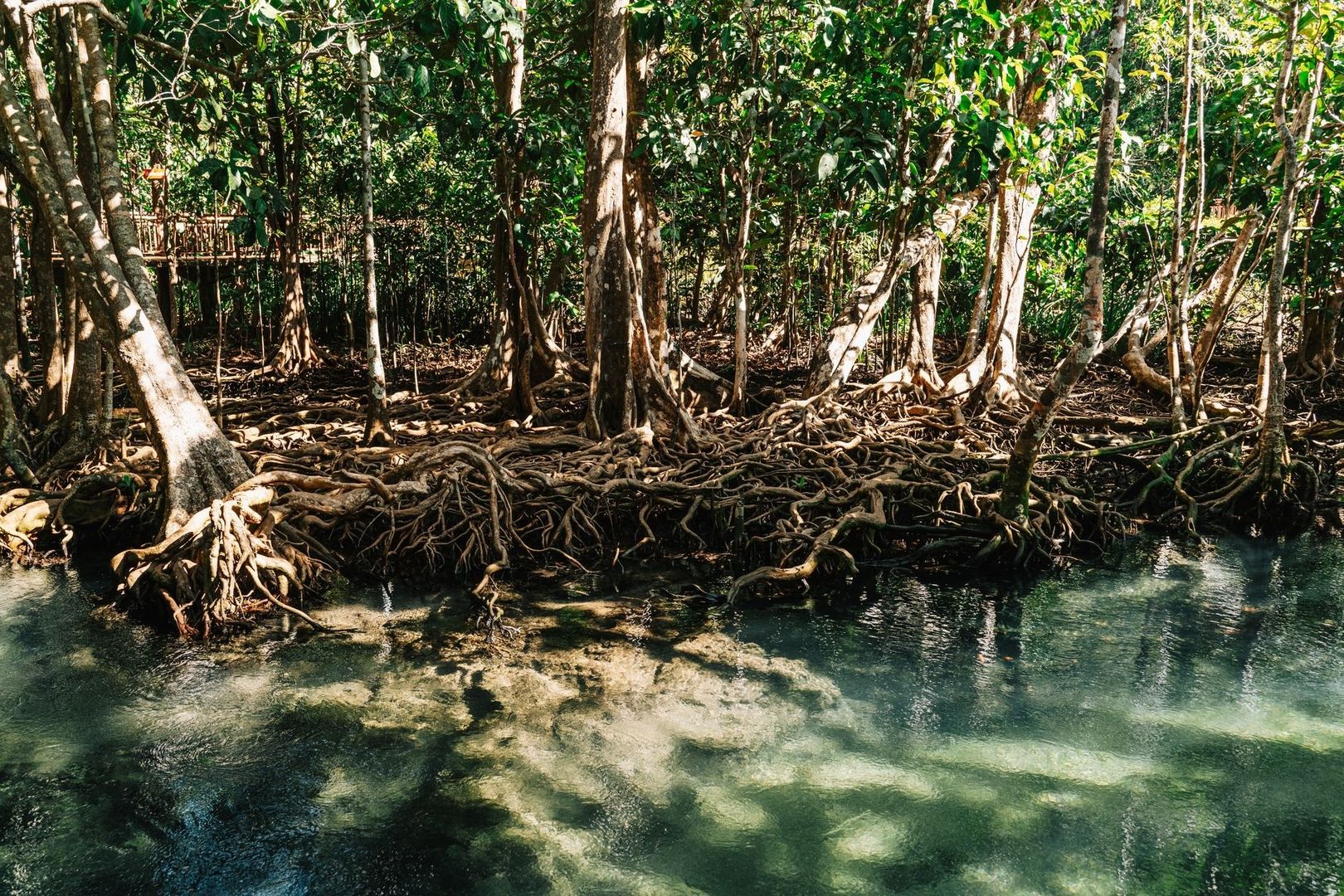
These structures do far more than hold trees upright. Red mangrove prop roots slow moving water, catch suspended sediment, and gradually build a more stable shoreline margin. Black mangrove roots also bind sediment and reduce erosion, while the combined forest dampens wave energy before it reaches homes, roads, beaches, and seagrass flats. During tropical storms, no mangrove can guarantee protection from extreme conditions, but an intact stand provides a much stronger natural buffer than a fragmented or heavily altered shoreline. Research from the University of Florida”s IFAS Extension explains that mangroves supply storm protection, erosion control, carbon storage, fishery support, and wildlife habitat, and that removing biomass can weaken those services.
Saltwater survival requires a remarkable collection of adaptations. Red mangroves limit salt uptake at the root level, while black mangroves can move salt into specialized leaf tissues and shed it. Their floating propagules and seeds help new trees colonize suitable edges as tides distribute them along the coast. For paddlers, the practical lesson is straightforward: roots, seedlings, branches, and leaf litter are active parts of a living coastal defense system, not obstacles to be pushed aside. When exploring coastal botanical zones, understanding how native species withstand extreme conditions is essential.
| Mangrove | What you may see from a paddlecraft | Ecological role |
|---|---|---|
| Red mangrove | Arching prop roots and suspended propagules | Traps sediment, shelters young marine life, and stabilizes tidal edges |
| Black mangrove | Vertical pneumatophores and salt-speckled leaves | Supports oxygen exchange, filters salt, and reduces erosion and wave energy |
The Submerged Nursery Sustaining Marine Life
Below the surface, the tangled root matrix functions like a three-dimensional nursery. Small fish can slip between prop roots, where larger predators have less room to maneuver. Shrimp, juvenile crabs, snails, and other invertebrates use the structure for shelter, while fallen leaves enter the food web as they break down. Many animals later move between mangrove creeks, seagrass beds, and offshore reef habitat as they grow. This exchange is one reason a seemingly narrow backwater channel can matter to marine life far beyond the shoreline.
The mangrove margin also supports species that are easy to miss unless a paddler slows down. Wading birds may feed along exposed mudbanks or gather in rookeries, raptors often rest on high branches, and tree-climbing crabs can appear briefly on trunks and roots. Shallow coastal and brackish habitats are also important to young smalltooth sawfish, the only sawfish species found in Florida waters. According to the Florida Fish and Wildlife Conservation Commission, the species is federally endangered, and smaller individuals use shallow nursery habitats. Any sighting should be observed without pursuit, crowding, or attempts to touch the animal.
The nursery works because nutrients and organisms move with the tides. Organic material produced inside the forest enters creeks and adjacent seagrass areas, while tides carry small animals between protected shallows and the broader reef tract. That connection makes mangroves part of a much larger coastal engine. Even urban or fragmented mangrove patches can retain value by filtering runoff, moderating wave energy, storing carbon, and providing habitat for fish and nesting birds. A quiet craft offers an unusually clear view of this relationship, but only when the route is chosen and navigated with care.
- Look between roots for juvenile fish, shrimp, crabs, and small rays.
- Scan the canopy and upper branches for herons, egrets, osprey, and other resting birds.
- Keep a wide distance from sawfish, manatees, dolphins, and any animal that changes direction because of your approach.
- Carry binoculars or use a camera with optical zoom instead of moving closer.
Tides and Timings for Effortless Backcountry Navigation
Tide planning is one of the most useful skills for a Florida Keys paddle. Local tide tables show the predicted height and timing of high and low water, but conditions can vary with wind, storms, atmospheric pressure, and the shape of individual creeks. Before launching, compare the tide prediction with the route”s known shallow spots. A falling tide can leave a kayak grounded on a mudflat and expose fragile seagrass beds to accidental contact. A rising tide may make a narrow passage easier, but it can also increase current speed in constricted channels.
The most comfortable window for a tight mangrove tunnel is often near high slack water, the short period when the tide has reached its high point and current temporarily weakens before reversing. Exact timing differs by location, so do not treat slack water as a universal appointment. Ask a local outfitter or park contact about the route, identify turning points before departure, and avoid entering a tunnel that will become difficult to exit as the tide changes. Guided trips can be a good fit for first-time visitors because experienced operators account for local tides, route conditions, weather, instruction, and safety.
Wind deserves equal attention. A morning forecast may look calm while an afternoon sea breeze creates a tiring return across open flats. Plan the exposed portion of a route early, keep track of drift, and note landmarks rather than relying only on a phone map. Heat management is essential even on breezy water. Wear sun protection, carry more drinking water than seems necessary, and use a dry bag for communication equipment. For extended backcountry routes, a whistle, basic first-aid supplies, navigation backup, and a clear turnaround time are sensible additions.
- Check the tide, wind, heat index, and storm forecast for the exact launch area.
- Match the route to the tide, allowing extra time for pauses, wildlife viewing, and a slower return.
- Mark shallow flats, narrow tunnels, emergency exits, and the planned turnaround point.
- Launch early when possible, before heat and afternoon wind become the dominant factors.
- Leave a route plan with someone on shore, especially for self-guided outings.
Low Impact Paddling Etiquette for Delicate Mangrove Canals
Good technique protects both the habitat and the quality of the experience. Use short, controlled strokes in narrow channels instead of powerful sweeps that churn bottom silt. Keep the paddle blade vertical and close to the boat or board, and do not use roots as handholds or push off them to gain momentum. On a SUP, kneeling through especially tight passages can improve balance and reduce the risk of falling into roots. If a channel is too shallow, turn around rather than dragging a craft across mud or seagrass.
Wildlife needs space, especially during nesting and resting periods. Avoid rookeries, never land on small islands unless access is clearly permitted, and do not surround a manatee resting in a brackish run. If a bird repeatedly calls, leaves its nest, or changes position because of a paddler, the distance is too short. Leave No Trace on saltwater means packing out food scraps, fishing line, and every piece of plastic, keeping voices low, avoiding amplified music, and using established launch points. Mangrove branches should never be trimmed to make a passage easier. Florida guidance notes that even well-intentioned cutting can reduce leaf area, recovery, storm resilience, and habitat value.
- Stay in deeper marked channels when available and avoid crossing exposed seagrass beds.
- Do not touch prop roots, pneumatophores, coral, wildlife, or floating propagules.
- Keep food, sunscreen containers, and drink packaging secured so nothing blows overboard.
- Use biodegradable practices where possible, but remember that “biodegradable” items still do not belong in the water.
- Follow protected-area rules, speed limits, launch restrictions, and seasonal wildlife closures.
Chart Your Next Sustainable Paddle Through the Keys
The most memorable mangrove outings are built on a simple exchange: the ecosystem offers shelter, wildlife, shade, and a close look at coastal life, while the paddler offers patience and restraint. Every quiet stroke helps reduce disturbance, and every decision to stay in a channel or turn away from a nesting site supports the shoreline”s long-term resilience. Mangroves are the biological heartbeat linking the Keys” land, shallows, seagrass, and reef, so protecting them improves the entire journey offshore.
For a first visit, choose a reputable local guide who explains tides, wildlife distances, and low-impact technique rather than promising guaranteed animal sightings. Small-group trips with included safety equipment can simplify logistics, while experienced paddlers may prefer a permitted self-guided route after checking tides, weather, access rules, and emergency options. Book ahead during winter and holiday periods, launch early in hot months, and keep plans flexible when wind or storms develop. The best way to explore the Florida Keys mangroves is to leave them looking exactly as they did before the paddle began.