Beneath the Surface: What It Takes to Save the Florida Keys Barrier Reef
Into the Turquoise Heart of North America’s Only Living Barrier Reef
Drop beneath the surface anywhere from Key Largo to the Lower Keys and the Florida Reef Tract reveals itself in layers of blue. Sunlight moves across coral heads, parrotfish crop algae from limestone, and barracuda hold their position above channels shaped by centuries of wave and current. For divers and snorkelers, the experience can feel effortless, yet this underwater landscape is one of the most important and closely watched ecosystems in North America. Before planning a reef day, visitors can also explore practical options for a Florida Keys travel guide to understand distances, weather, launch points, and conservation-minded operators.
The Florida Reef Tract is the world’s third-largest barrier reef and the only living barrier reef in the continental United States. It supports fish nurseries, sea turtles, sponges, seagrass meadows, mangroves, commercial fisheries, coastal protection, and a tourism economy built around clear water. Its condition is serious: NOAA reports that the Keys have lost nearly 90 percent of the formerly dominant live corals over roughly four decades. Still, the story is not limited to decline. Across the islands, scientists are growing corals in nurseries, testing heat tolerance, restoring grazers, and building partnerships that put conservation directly into the hands of local businesses and visitors.
Understanding the Pulse of the Florida Reef Tract
Healthy reefs depend on foundation species that create three-dimensional habitat. Elkhorn coral, or Acropora palmata, forms broad branching thickets in shallow, high-energy water. Staghorn coral, or Acropora cervicornis, produces antler-like branches that shelter juvenile fish and invertebrates. These fast-growing corals are more than colorful scenery. Their structure provides hiding places, feeding surfaces, and nursery habitat, while the reef framework helps dissipate wave energy before it reaches shore.
The losses have accumulated through several overlapping pressures. Disease, including white band disease and stony coral tissue loss disease, has removed living tissue from colonies. Marine heatwaves cause corals to expel the microscopic algae that supply much of their energy, producing bleaching and, when stress persists, death. Hurricanes can break colonies and shift rubble across the seafloor. Runoff carrying nutrients, sediments, petroleum products, and other pollutants can reduce water quality, encourage algae, and interfere with coral growth. Anchors, vessel groundings, careless contact, fishing pressure, and marine debris add physical and ecological stress.
The historical comparison is stark. NOAA Fisheries describes a reef system that has lost almost nine-tenths of its formerly dominant live corals, while NOAA’s account of elkhorn coral recovery records a decline of about 97 percent from former abundance beginning in the 1980s. Recent heat extremes have made the baseline even more difficult. In 2023 and 2024, NOAA documented extraordinary mortality among known wild and restored elkhorn colonies in the Keys. Researchers monitoring key reef builders note the severe pressures faced across historical decades in NOAA Fisheries documentation.
That evidence warrants urgency, not resignation. A damaged reef still contains living organisms, genetic material, surviving fish communities, and places where restoration can take hold. The most useful response combines climate action with local measures that give corals a better chance to survive and reproduce.
- Heat stress: Warmer water drives bleaching and weakens coral energy reserves.
- Disease: Tissue loss can spread across colonies and reduce already fragmented populations.
- Poor water quality: Excess nutrients and sediment favor algae and interfere with reef growth.
- Physical damage: Anchors, groundings, fins, fishing gear, and debris can break fragile colonies.
- Ecological imbalance: The loss of herbivores allows algae to compete with young corals for space.
Inside Mission Iconic Reefs and Next-Generation Coral Nurseries
Mission Iconic Reefs is designed as a long-term, ecosystem-scale response rather than a series of isolated coral plantings. NOAA and its partners selected seven ecologically and culturally important reef sites within the Florida Keys National Marine Sanctuary. The ambition is substantial: restore nearly three million square feet of reef habitat, an area comparable to 52 football fields, over a multidecade program. The plan combines field restoration, research, monitoring, permitting, public education, and community stewardship.
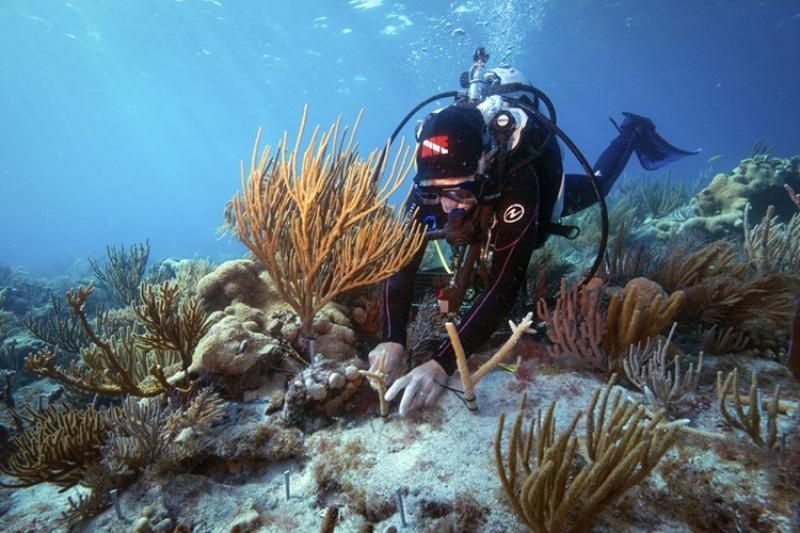
The first phase emphasizes fast-growing elkhorn and staghorn corals because their branching forms can rebuild habitat relatively quickly when conditions allow. Coral fragments are grown in land-based or offshore nurseries and later attached to reef surfaces. Micro-fragmentation accelerates this process by cutting coral into small pieces that can grow rapidly and fuse together once placed close to one another. Restoration teams also maintain genetic diversity, test disease resistance, and investigate which coral strains and symbiotic algae perform best under heat stress. Offshore nursery trees, suspended in the water column, provide a practical way to grow many fragments while keeping them above the seafloor.
Restoration science is not a single recipe. Different hubs and projects use different techniques according to species, depth, water movement, disease exposure, and available space. The comparison below shows how the approaches fit together.
| Restoration approach | Best suited to | Primary advantage | Key resilience question |
|---|---|---|---|
| Micro-fragmentation | Massive and slower-growing corals | Speeds up colony formation and fusion | Can larger colonies survive future heat and disease? |
| Offshore nursery trees | Branching elkhorn and staghorn corals | Produces many fragments in suspended habitat | Which genetic lines retain growth and survival? |
| Genetic management | Multiple restored coral species | Preserves diversity and identifies resilient colonies | Can useful traits be maintained without narrowing the gene pool? |
| Grazer restoration | Reefs with heavy algal competition | Restores animals that keep surfaces available for coral settlement | Will grazer populations remain stable under changing conditions? |
Later phases are intended to add slower-growing corals and algae-eating species, including restoration experiments involving Caribbean king crabs. The goal is not simply to create attractive patches of coral. Mission Iconic Reefs targets diversity, structure, fish habitat, and ecological function, with planning benchmarks that seek average coral cover of 15 percent in an initial phase and 25 percent by the end of a subsequent phase. Every outplanting must be monitored, maintained, and evaluated against real conditions in the sanctuary.
That is why a nursery is best understood as a bridge, not a substitute for a healthy ocean. Corals can be bred and planted, but extreme heat, disease, poor water quality, and repeated storms can overwhelm even excellent restoration work. The strongest strategy pairs nursery innovation with greenhouse-gas reductions, water-quality improvements, habitat protection, and careful management of human use.
How Mindful Travelers Can Protect the Living Seascape
A reef trip begins before the boat leaves the marina. Choose an operator that treats conservation as part of the service, not as a brief speech before entering the water. NOAA’s Blue Star program recognizes businesses that commit to responsible practices, visitor education, and protection of the Florida Keys National Marine Sanctuary. Booking with a certified Blue Star operator helps direct demand toward businesses that support long-term stewardship and often gives visitors clearer guidance on buoyancy, wildlife encounters, mooring systems, and site conditions.
In the water, the most important rule is simple: look, do not touch. Coral may appear rock-like, but it is a colony of living animals. A fin, hand, camera housing, dangling gauge, or unsecured snorkel can break tissue and branches that took years to grow. Divers should complete a buoyancy check, remain horizontal where conditions permit, keep equipment streamlined, and select safe entry and exit points. If equipment needs adjustment, return to the boat or use a designated sandy area rather than standing on the reef.
Mooring buoys are there to prevent anchor damage, so use them correctly and follow the captain’s instructions. Never drop an anchor onto coral, and avoid shallow areas where propellers, fins, and inexperienced maneuvering can cause disproportionate harm. Snorkelers should use a properly fitted snorkel vest when extra flotation is needed; loose pool noodles can drift away and become marine debris. Keep a comfortable distance from turtles, rays, sharks, dolphins, and other animals. Feeding, chasing, handling, or blocking wildlife changes natural behavior and can create risks for both animals and people.
- Use mineral-based sunscreen, preferably applied well before entering the water, and rely on shade, protective clothing, and a hat for additional coverage.
- Secure cameras, gauges, hoses, fins, and flotation devices so nothing trails across coral.
- Stay off the bottom, especially in shallow water, and practice buoyancy skills before visiting a delicate site.
- Leave shells, coral fragments, rocks, and historical artifacts where they belong.
- Carry out fishing line, wrappers, bottles, and any other debris found safely without disturbing wildlife.
- Follow sanctuary rules, seasonal closures, no-take zones, and instructions from local guides.
Responsible travel also includes realistic planning. Wind, thunderstorms, visibility, currents, and sea conditions can change quickly, and a canceled snorkel is preferable to a dangerous or damaging outing. Ask operators how they respond to coral disease, whether they participate in monitoring, and how they train guests. A thoughtful booking supports local crews while strengthening a culture in which every visitor understands that the reef is a living place, not an underwater attraction to be handled.
Five Simple Ways to Champion Coral Health From Shore to Open Water
Visitors do not need a marine biology degree or a private boat to contribute. Small choices become meaningful when repeated across thousands of trips each season. The following checklist works for first-time snorkelers, experienced divers, families, and travelers spending only a few days in the Keys.
- Choose a conservation-minded operator. Look for a Blue Star business, ask about reef practices, and select guides who explain buoyancy, wildlife distance, mooring buoy etiquette, and sanctuary regulations.
- Practice before reaching the reef. Divers should check weighting and buoyancy in a sandy area. Snorkelers should adjust masks and flotation at the boat, not while standing on coral or seagrass.
- Join observation and monitoring efforts. Citizen science platforms and reef-monitoring apps can allow visitors to record species, bleaching, marine debris, and unusual conditions. Use only approved programs and follow photo and distance rules so documentation does not become an additional disturbance.
- Ask about volunteer nursery days. Local restoration organizations periodically offer opportunities to help with nursery maintenance, fragment care, educational events, or shoreline cleanups. Availability, training, and age requirements vary, so arrange participation before arrival.
- Reduce pollution before leaving the dock. Refill a durable bottle, avoid single-use plastics, dispose of fishing line properly, keep fuel and detergents out of storm drains, and use only the amount of fertilizer needed at home. Nutrient pollution from residential wastewater, stormwater, and landscaping can eventually reach connected coastal waters.
Actions on land matter because the Keys are hydrologically connected. Nutrients can fuel algal growth, while plastic, fishing gear, and abandoned equipment can entangle animals or abrade coral. Propeller scars damage seagrass meadows, which serve as nurseries and help stabilize coastal sediments. Visitors driving across the islands can help by choosing refill stations, packing reusable food containers, and supporting businesses that minimize disposable packaging. These habits are modest, but they address the same pressures that restoration teams must manage around every outplanting site.
Be Part of the Living Solution Beneath the Keys Horizon
The Florida Reef Tract is being restored through an unusually broad alliance. Scientists develop resilient coral lines and refine nursery methods. Restoration divers attach fragments and inspect them after storms. Sanctuary managers protect sites and coordinate rules. Dive masters teach visitors how to hover above the reef, secure their equipment, and read changing conditions. Local residents, charter crews, educators, and travelers all influence whether conservation becomes a lasting part of Keys culture.
Every careful fin stroke helps when it avoids contact, every mooring buoy prevents anchor damage, and every reef-conscious booking rewards businesses that protect the places they depend on. Visit with curiosity, plan around weather, listen closely to local guides, and treat the water as a living community rather than a backdrop. Beneath the Keys horizon, recovery will require patience and sustained work, but thoughtful travelers can help give that work room to succeed.